
DESERT or WILDERNESS (1840)
An excerpt from “A Key To The Symbolical Language Of Scripture” by Thomas Wemyss, 1840, pp. 128-132. Archaic spelling updated.
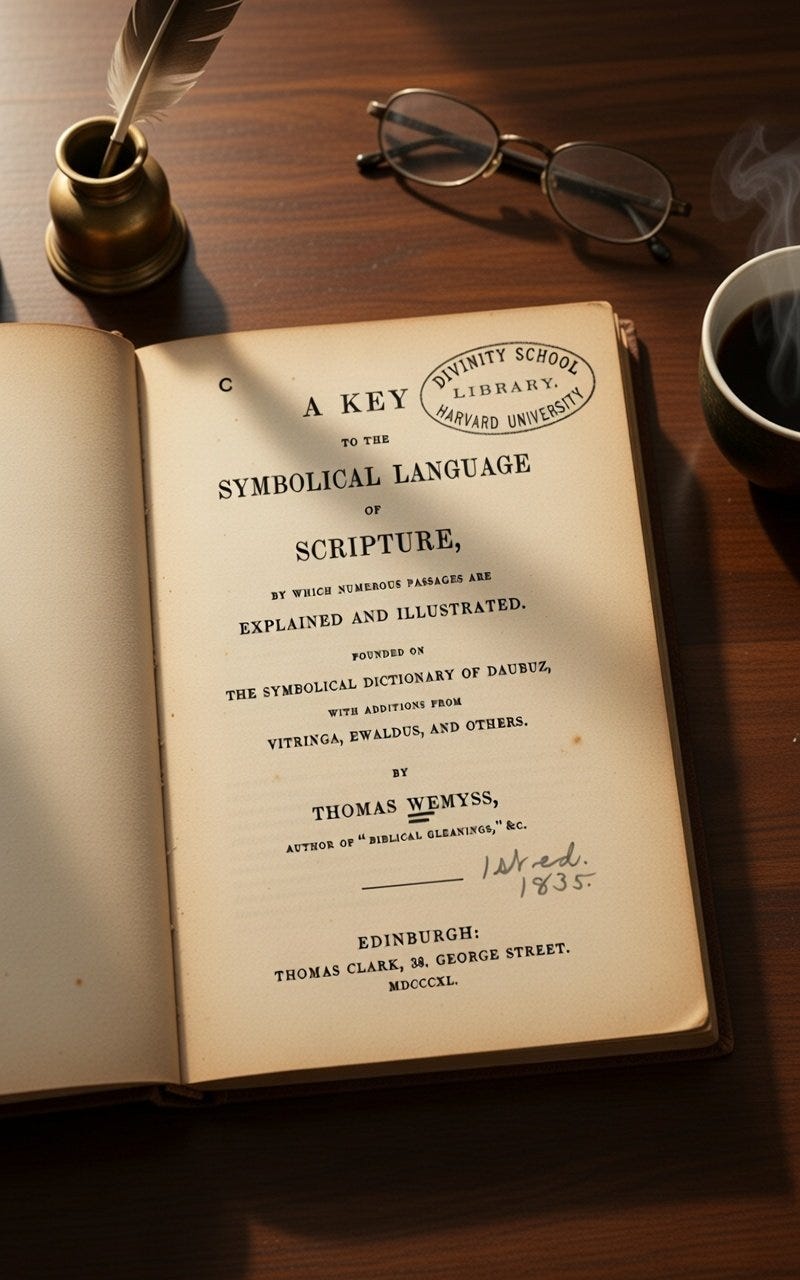
DESERT or WILDERNESS.
A place remote from the society and commerce of men; the symbol of temptation, solitude, persecution, desolation, and the like. Thus in Isaiah 27:10, “The strongly fortified city shall be desolate, An habitation forsaken, and deserted as a wilderness.” And in chapter 33:9,
“The land mourneth, it languisheth, Lebanon is put to shame, it withereth, Sharon is become like a desert, Bashan and Carmel are stripped of their beauty.”
And thus Æneas in Virgil, to shew the misery of his condition, mentions his wandering unknown and needy in a wilderness, Æn. b. 1, v. 388.
“Ipse ignotus, egens, Libyæ deser peragro.”
But a wilderness may also be a symbol of good, when it denotes a hiding place from enemies, as David often found it; and as the Israelites did in the persecution of Antiochus, when the Gentiles had profaned the sanctuary.
Deserts are sometimes emblematic of spiritual things, as in Isaiah 41:19,
“In the wilderness I will give the cedar, The acacia, the myrtle, and the tree producing oil, I will plant the fir-tree in the desert, The pine and the box together.”
So in chapter 32:15,
“Till the spirit from on high be poured out upon us, And the wilderness become a fruitful field, And the fruitful field be esteemed a forest, And judgment shall dwell in the wilderness, And in the fruitful field shall reside righteousness;”
meaning nations in which there was no knowledge of God, or of divine truth, shall be enlightened and made to produce fruit unto holiness.
Deserts are generally pathless. In reference to this Isaiah says, chapter 35:8,
“And a highway shall be there, And it shall be called the way of holiness: No unclean person shall pass through it, But he himself shall be with them, walking in the way.”
He himself, i. e. God, who shall dwell among them, and set them an example that they should follow his steps.
The desert is the symbol of the Jewish church and people; Isaiah 40:3,
“A voice crieth in the wilderness.”
The Jewish church, to which John was sent to announce the coming of Messiah, was at that time in a barren and desert condition, unfit without reformation for the reception of her king. See the whole of Lowth’s note in loco. See also Ezekiel 478.
The desert seems also to be the symbol of the antichristian empire; Revelation 17:3.
It was in the wilderness that John saw the vision of the woman clothed in purple, and since this woman denotes mystic Babylon, the wilderness may be understood to be the figure of her power.
It is of the conversion of the Gentiles the prophet speaks, when he says, Isaiah 35:1,
“The wilderness and the solitary place shall be glad for them, The desert shall rejoice and blossom as the rose.”
The solitude of the desert is a subject often referred to thus Job 38:26,
“To cause it to rain on the earth, where no man is, On the wilderness, wherein there is no man.”
Jeremiah 9:2,
“Oh that I had in the wilderness a traveller’s lodge, That I might leave my people, and go from them!”
By a traveller’s lodge, meaning some cave or hut, which some one before him may have erected for a temporary shelter.
Horace describes the desert, as “terram domibus negatam,” and elsewhere,
“Sive facturus (iter) per inhospitalem Caucasum;”
and Propertius, 1. 1, el. 10,
“Hæc certe deserta loca et taciturna querenti, Et vacuum zephyri possidet aura nemus, Hic licet occultos proferre impune dolores;”
that is, without any one’s presence or knowledge. The desert is the abode of evil spirits, or at least their occasional resort. See Matthew 12:43; Luke 11:24. The heathen also held this opinion, witness Avian, fab. 29,
“Hunc nemorum custos fertur miseratus in antro Exceptum Satyrus continuisse suo;”
and Virgil, Æn. 6, v. 27,
“Tum vero in numerum faunos ferasque videres Ludere,” &c.
The Shedim or dæmons of Scripture appear to have been the satyrs and fauns of the Gentiles, whom the Israelites idolatrously served. Deuteronomy 32:17; Psalm 106:37. Shedim being derived from shed to lay waste or desolate. See Isaiah 34:14, and Jeremiah 1:38, 39. And Maimonides, speaking of the Zabians, says, “They relate in their books, that on account of the wrath of Mars, desert and desolate places are without water and trees, and that horrid demons inhabit those places.”
Matthew 13:43, is thus paraphrased by a foreign writer: “The devil being expelled from the Jews, passed over to the Gentiles, but when by the light of the Gospel he was driven from thence, and found no resting place, he returned to the blinded Jews, and took possession of them more than before.”
The desert is described as a place of great perils through robbers and assassins. See Lamentations 4:19,
“They laid wait for us in the wilderness.”
Acts 21:38,
“Art not thou that Egyptian, who leddest out into the wilderness Four thousand men that were murderers.”
See Josephus, Antiq. 1. xx. 6. And Paul, 2 Corinthians 11:26, mentions “perils in the wilderness.”
To the primitive Christians, the world was every where a wilderness of this kind; hence they are called pilgrims and strangers, who had no abiding city. And by the heathen they were often classed with and treated as robbers, according to the inscription which Scaliger cites. Neroni Claudio Cæsari Aug. Pontif. Max. ob provinciam latronibus et his qui novam generi humano superstitionem inculcarant purgatam; i. e. to Nero Claudius Cæsar Augustus, high priest, on account of his having cleared the province of robbers, and of those who taught mankind a new superstition.